


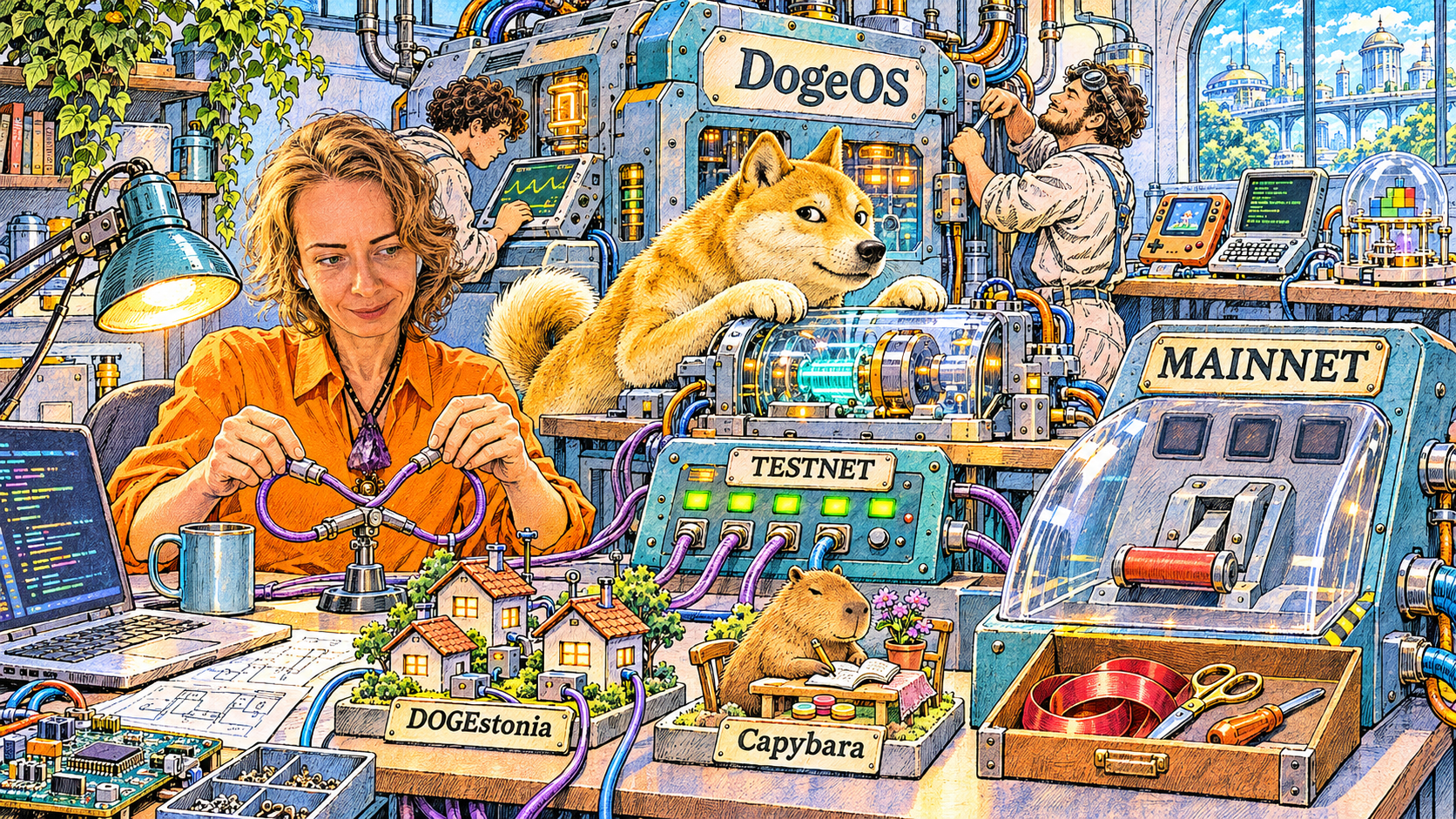
The dog is getting a workshop. Why I'm waiting for the DogeOS mainnet
If Dogecoin applied for a job, the interview could turn out rather strange.
— What can you do?
— Send money. Accept tips. Bring people together around a photo of a dog.
The HR manager's pen would hover over that last point. He himself brought people together around the holiday spreadsheet, with more modest results.
— And apps? Games? Services?
— They're just fitting out a workshop for me.
This workshop is called DogeOS. And right now I'm waiting for its mainnet to open — the main network where real assets will be used. My own constructions are already standing on its test bench. But first, about the workshop itself.
What exactly is being launched
Dogecoin already has a working main network. Nobody is launching it again.
DogeOS is a separate network for applications being built on top of Dogecoin. It adds an environment for smart contracts: programs that execute the rules written into them. This makes it possible to build more complex services around DOGE than a simple coin transfer.1
Imagine a shared fundraiser for workshop equipment. In one case, a person sends money to the organiser and then waits for news. In the other, some of the conditions can be written into a program: how much needs to be raised, by what deadline, when the funds can be used, and what happens if the required amount isn't reached.
This is an example of a possible application. The program won't deliver the equipment itself. If the agreement forgot about delivery, a lathe won't materialise out of the blockchain.
But it becomes possible to define some of the rules in advance and check how they are carried out. For me, this is exactly where the interesting work begins.
As of 12 November 2026, the DogeOS mainnet is still ahead. In an interview published by The Block on 11 November, founder Jordan Jefferson said that development of the first version and the audits are complete and the main network launch is close. He did not give a specific date.2
The celebratory ribbon can stay in the drawer for now. Next to the screwdriver.
Why does a dog need Ethereum compatibility
DogeOS is described as an “EVM-compatible network”. It sounds like a diagnosis that calls for replacing a cable.
In practice, it means compatibility with the environment that Ethereum applications are already written for. Developers get familiar tools and can reuse existing work. There's no need to start by inventing the hammer before nailing the first board.3
This doesn't mean any application can be moved over without checking anything. DogeOS has its own specifics. But entering the new ecosystem becomes far more practical: a programmer arrives with their own toolbox and can get to work straight away.
Fees on DogeOS are paid in DOGE. What's more, native DOGE has a standard ERC-20 token interface for interacting with applications: in many scenarios there's no need for a separate operation to “wrap” the coin in another technical shell.4
For an ordinary person, the value of such decisions is very simple: fewer intermediate steps to understand, carry out and not mix up.
This question has occupied me for a long time. How interesting must a technology be for a person to agree to first acquire a second profession for its sake? I prefer to build so that the profession stays with the developer.
The test bench already has electricity
The public DogeOS test network opened on 30 September 2026. It is called Chikyū. There, developers can deploy contracts, test applications and try out transfers before the main network launches.5
Testnet is a full working environment for testing, but with test coins. They are obtained for experiments; they should not be thought of as future real DOGE. A test-bench balance does not by itself turn into money once the mainnet opens.
This is a convenient place to discover that the confirm button is in the wrong spot, a transfer followed the wrong scenario, and a person understood the instructions completely differently from their author.
The last one is especially useful. Code usually at least reports an error. A person sometimes simply closes the page.
In the documentation, the team gives benchmarks of about three seconds per block and roughly 300 transactions per second. These are characteristics stated by the developers, not a promise that any action in any future application will take exactly three seconds.3
For example, the bridge between Dogecoin Testnet and DogeOS Testnet runs on its own schedule: the guide allows up to four hours per transfer in each direction. It also states plainly that this is an early test implementation.6
That's why the whole user journey needs testing. A fast engine doesn't yet guarantee that the passenger will quickly find the station exit.
What the mainnet will change
The main change is the cost of a mistake.
On the test network you can test a fundraiser, a transfer or a game mechanic without test coins having real value. On the main network, real economic responsibility appears: users' funds, fees, the consequences of a failed contract.
For app creators, this is the move from testing to being able to run live services. For users, it's the chance to use them with real assets, as each product becomes ready.
That's exactly why the approaching mainnet makes me happy. Prepared infrastructure can become the basis for everyday actions: paying, getting a service, using an app, keeping an agreement. Then the most interesting thing will become clear — which of these actions people really need.
DogeOS's September announcement already lists teams working on exchange, lending, a stablecoin, games and consumer apps. For example, Superposition Finance is working on a lending protocol, USDoge on a collateralised stablecoin, PlaysOut on gaming. Each project has its own schedule: the network launch doesn't mean all services are ready at the same time.5
What attracts me most is the possibility of small useful systems appearing. Ones whose usefulness can be explained without a forty-slide presentation.
One person did something. Another person got the result. Both are left with clear confirmation of what they agreed on.
The entrance should be on the people's side
There's another part of the infrastructure that's easy to underestimate: how you get into an app at all.
DogeOS already has tools for connecting an existing wallet and signing in with familiar methods — email, Google or X. Inside MyDoge, connecting the app's own wallet is supported.7
This matters for anyone who wants to build a service for people who have their own business to attend to. They came to reach an agreement with neighbours or sort out a purchase. An invitation to first study how cryptographic keys work may hold them up a little.
Of course, a convenient sign-in doesn't remove questions about control over the wallet and access recovery. They have to be solved within each specific product. But being able to start with an action that makes sense to a person already changes a lot.
I want complexity to stay where it can be maintained. An engineer may well have a bundle of wires under the desk. On the user's desk, the lamp should simply work.
What I want to check before the ribbon is cut
The word “blockchain” by itself doesn't yet answer the question of who controls what.
Who can upgrade the system? Who keeps the bridge running? How can an app be restored? Which actions must the user confirm personally?
In its own overview, the DogeOS team writes that further work includes decentralising components. So readiness of the first version and full distribution of the whole system are different stages.1
The design is also more interesting than a simple picture of “everything is stored on Dogecoin”. According to the documentation, transaction data is published to Ethereum to ensure its availability, and fees cover execution, data and the operation of the link to Dogecoin.8
I see this as an engineering structure with several parts. Each needs its purpose and limits understood. Then you can decide meaningfully what exactly to build on it.
Checks don't spoil the joy of waiting for me. Even with a bridge over a stream, I'd choose the one whose fastenings have been inspected. Even if a very charming dog is painted on the railings.
And now — what's already on my test bench
For me, this story moved beyond reading the news long ago.
DOGEstonia is already in progress on DogeOS TestNet. The Capybara family system is also running for me on this test network. This is my current hands-on experience; I don't infer the readiness of the whole ecosystem from it.
There's already an architecture and a substantial amount of written code behind it. Many parts have been assembled: the inter-node federation, a system of exclusive community access via Invite NFT, $LOVE social mining and an e-commerce foundation for a P2P marketplace. I'll keep the details of the inner workings in the workshop for now.
For me, this is work at the intersection of programming and social engineering: designing rules for access, contribution, exchange and relationships between independent participants. It's important to think through in advance what power each side gets and what happens in a conflict. A friendly token name won't do this work for us.
In DOGEstonia, the entry point is community life: a person tells what's happening nearby, and individual stories help reveal a shared need. There's a working example in Uus Veerenni in Tallinn. Connecting independent nodes into a federation is the next stage, for which part of the architecture and implementation is already prepared.9
For Capybara, the scale starts with the family: learning, clear agreements, effort, CAPY, savings and obligations. The family practice already exists, while the client dashboard is still in development.10 The fact that the technical side is being tested on TestNet doesn't make household agreements make-believe. The family will explain the difference very quickly.
So I'm waiting for the DogeOS mainnet with quite specific plans: to keep testing the finished parts, connect them and prepare them step by step to run on the main network.
You could say I'm creating a quantum entanglement of DOGEstonia and DOGE OS. In my engineer-witch version, it is established through shared protocols, code and persistence. Pull on one task, and another one turns up at the other end.
Meanwhile, the dog is getting ready to open the workshop. I've already claimed the corner by the socket.
DOGEstonia
A node of your own for your community
A courtyard, a village, a club or a district: tell us what's happening around you. We'll help launch a node where individual stories add up to shared decisions, while the infrastructure and accounts stay with the community.
Discuss a node for my communityCapybara
Family agreements you can see
Learning, effort, pocket money and shared house rules. We'll look at your situation and choose clear tools — starting in writing.
Tell us about our familySources
- What DogeOS is building and how the network is developing
- Founder interview on the approaching mainnet, 11.11.2026
- Compatibility and network characteristics
- DOGE inside applications
- Public TestNet opening and ecosystem projects
- How the test bridge works
- Connecting wallets and signing in to apps
- Fees and data availability
- DOGEstonia landing page
- Capybara landing page
Read also




 English
 Russian
 Estonian
 Spanish
 French