


A child doesn't understand a word problem: is it the language or the maths?
Picture an ordinary evening. A textbook lies on the table, a cup of tea cools beside it. The adult reads the problem aloud for the second time. The child stares at the same line and twirls a pencil.
— What's unclear here? It's all written down.
— I know the words.
— Then solve it.
The pencil keeps spinning. The adult is about to read the problem louder. Yet volume is the only quantity in this problem that anyone has managed to increase so far.
It is easy to mistake an evening like this for an argument about effort. But first it helps to find out which action is out of reach right now. Understanding the words, seeing the mathematical relationship and organising the written work are three different demands. They can all meet in a single sentence.
If the family speaks Russian at home and the child studies in Estonian at school, there is one more job: linking the meaning the child understands with the school's wording. The parent may need help with the language too. This limitation is worth taking into account when preparing a session rather than hiding it behind confidence.
Three questions instead of one “Did you get it?”
Start with what the child can show. “Who is it about? What do we know? What do we need to find out?” Sometimes the child names all the numbers correctly but doesn't see who the comparison refers to. Sometimes they retell the problem easily but don't know how to find the unknown. And sometimes they know the method and simply can't start: there are too many items on the page, it's unclear where to write, or there's little energy left today.
These are working hypotheses for choosing help. They don't allow you to make a diagnosis or to finally split abilities into language and maths. Several difficulties can act together. If reading aloud made things easier, all we have learned is that this form of access helped in this attempt.
It's handy for the adult to note three short observations: understood the question; showed the relationship; started an action. Next to them — what help was needed. A record like this is more useful than the general verdict “understands nothing again”: tomorrow it will be clear where to continue.
One problem and two rows of buttons
Let's take an invented practice example in Russian. It shows how the analysis goes; a checked translation of an Estonian school task is not offered here.
“Lena has eight buttons. Mark has three buttons fewer. How many buttons does Mark have?”
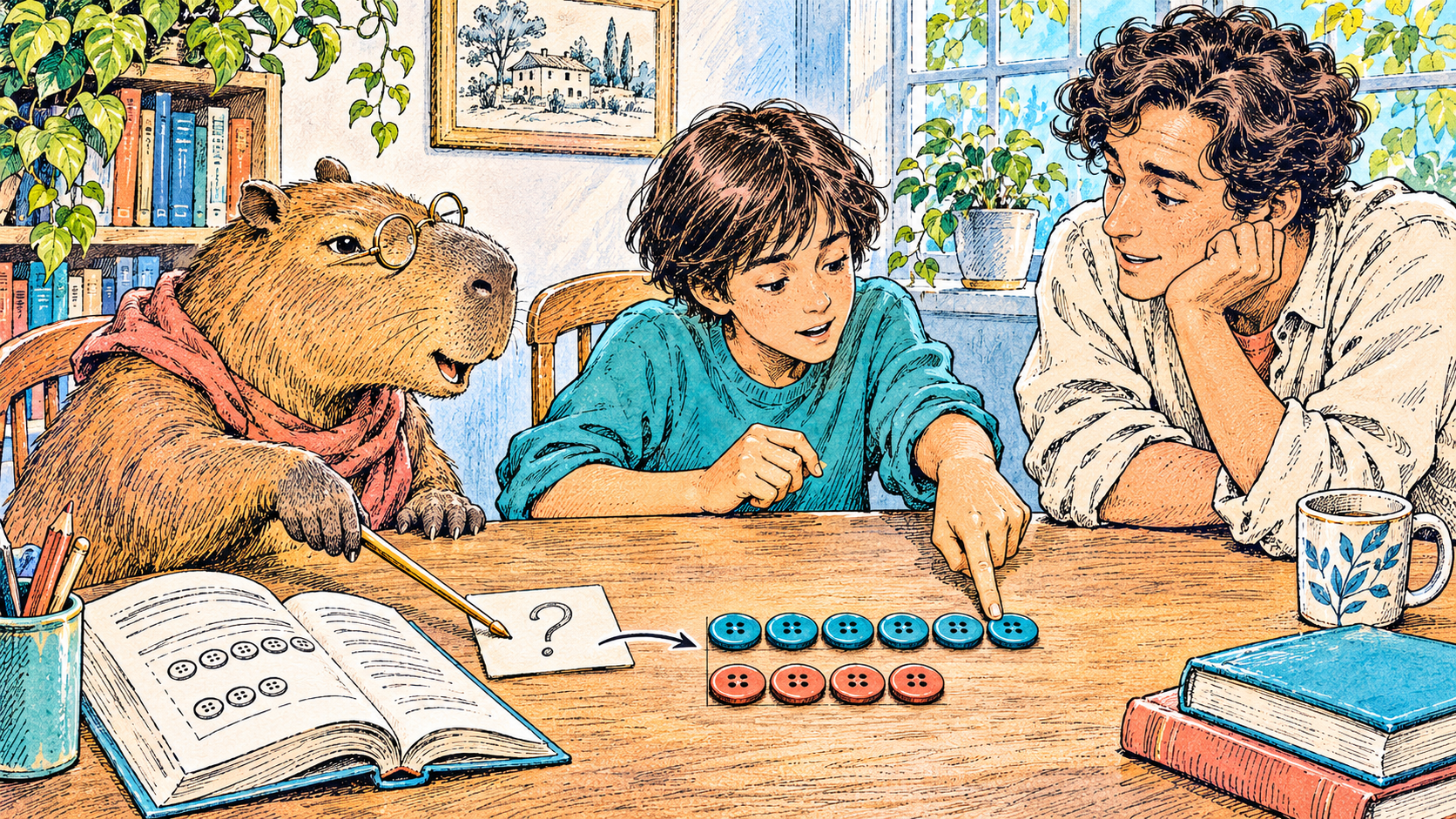
Don't start with “you need to subtract here.” Ask the child to show who has more buttons. You can draw two rows, lay out objects or mark lengths with strips. What matters is that the child can explain which row belongs to Lena and where the difference is visible.
— What do we know about Lena?
— Eight.
— And about Mark, do we know an exact number or only a comparison so far?
If it's hard to answer, go back to the objects. Lay out Lena's eight buttons and suggest making Mark's row next to it, with three fewer. Don't correct the movement in advance: watch how the child understands the relationship. Then ask how to check that the difference really is three.
You get five buttons: 8 − 3 = 5. The check brings back the meaning: Lena has eight, Mark has five, the difference is three. The written sum now stands for an action the child has already seen.
If the child builds a suitable diagram but makes a mistake in the calculation, the next help is about counting. If they count confidently but make Mark's row longer, it's worth working more on comparison. If it's unclear even who should be in the second row, it's better to sort out the problem statement first. There's no need to change everything at once.
What working memory may be doing here
Working memory is the name for the processes that help us hold information while working with it at the same time. A word problem requires remembering the question, connecting the data and choosing an action. For a home try-out you can put the data and the question on paper: then it's fine to come back to them instead of reproducing everything from memory.
In a study by Swanson, Kong and Petcu, 2019 , the executive component of working memory was linked to accuracy in solving word problems among Spanish–English children in grades one to three, taking into account a number of other measured skills. This is a cross-sectional study: it does not prove the cause of a particular child's difficulty. Nor did it test an Estonian school, AI translation or our button exercise.
The practical conclusion is more modest than a promise to “develop memory”: try reducing the number of details that have to be held at once and see whether the work changes. The diagram stays available for as long as it's needed.
How to return to the school's wording
After a clear walkthrough, open the original again. Find the expression that conveys the relationship “three fewer” and link it to the diagram you have already built. If the adult isn't sure of the meaning, check the wording with the teacher or someone competent in the language and the subject.
The home language can serve here as a way to try out an explanation. This is a teaching experiment, not a claim that translation is always more useful than working in the school language. What matters is not to lose the original problem: the numbers, the units, the participants, the direction of comparison and the question itself.
For the next attempt, change one detail. For example: Lena has nine buttons, Mark has two fewer. Now the answer is seven. See whether the relationship is built afresh. Repeating the previous answer “five” doesn't yet show that the method is understood. And one successful new problem doesn't complete learning the whole topic.
A younger child may find it easier to move objects around. An older one may prefer to mark the data and make a small dictionary of relationships. Choose the form that helps this particular child; not everyone needs a playful wrapper.
Where AI can save the adult's energy
You can hand AI the preparation: ask it to suggest a short rewording, questions and a separate key for the parent. Keep the original so there is something to check against. If you use a photo, remove unnecessary personal data and check that the problem was recognised correctly.
A prompt for the adult:
First, copy the given problem without changes. Mark unreadable places, don't guess. Then suggest a simple wording and three questions that will help the child see the relationship without hinting at the arithmetic operation. Give the parent's key separately. Check the numbers, units, participants, direction of comparison and the question between the original and the rewording. Task text: [insert the problem].
The model's answer also needs checking. If the language of the original isn't accessible to you, its confident message “everything has been preserved” does not replace a competent check. When in doubt, it's better to leave an unverified term open than to build a session on a mistaken translation.
The material can be printed out and worked on at the table. A family that needs a person nearby doesn't have to turn help into yet another screen lesson.
Special quests: when other difficulties join the language one
Choose a support based on what you observe. The situations listed occur in different children and on their own diagnose nothing. NICE NG87 describes the principle of individual environmental modifications for ADHD; CG170, recommendation 1.1.9 draws attention to clear visual supports and sensory needs in autism. The home tasks below are adaptation options, not interventions tested by these guidelines.
The question gets lost in a long problem. Perhaps less information per step is needed right now. Keep the question visible and help label the data. Quest: only show what needs to be found, without calculating. Success — the child points to the unknown in their own words or on the diagram. If even this causes tension, shorten the problem to a single relationship and postpone solving it.
The meaning is clear when spoken, but reading stops the work. Offer reading by the adult or checked text-to-speech. Quest: after one sentence, arrange two strips according to the problem. Criterion — the relationship is shown correctly; reading speed is not assessed here. If the spoken sentence is also too much, break it up. Don't take text-to-speech away after the first success.
A word is understood literally or ambiguously. Show two concrete meanings. Quest: choose which one fits this problem and show it with objects. Success — the choice can be linked to the problem, without guessing what the adult wants. If the argument revolves around the word, replace it with a clear phrase and come back to the term later.
Getting started just doesn't happen. Make the first step visible: “Just mark the number you know.” After that, offer to choose the next one. Criterion — one action has started, with support. If the child is exhausted, end the attempt; raising the reward won't make the instructions clearer.
What to try today
Choose one task and agree in advance that right now you are looking for the right kind of help. After the attempt, note: what was unclear, which support was useful, what the child did on their own. If it got harder, that's an observation too: reduce the amount or change the approach.
If difficulties are persistent and pronounced, or the child is very upset, it's worth discussing individual support with the teacher and a suitable specialist. A home try-out shouldn't turn into an endless test of ability.
It's also fair to admit something else: the problem doesn't have to be liked, and the adult doesn't have to replace all the school's explanations in one evening. For today it's enough to find one spot where help makes clear sense.
If you'd like to set up a process like this for your family, you can describe one situation in writing on the Capybara page. We'll work out which questions, materials and tools are worth trying. You can start with that very sheet on which the pencil hasn't yet left a single line.
Capybara
Let's look at your learning situation
Describe one task or one evening when everything got stuck. We'll choose questions, materials and tools that suit your child — and we'll start in writing.
Tell us about your difficultiesSources
- Swanson, H. L.; Kong, J. E.; Petcu, S. D. (2019). Individual differences in math problem solving and executive processing among emerging bilingual children. Journal of Experimental Child Psychology, 187, 104653. Abstract used.
- NICE. Attention deficit hyperactivity disorder: diagnosis and management, NG87, definition of environmental modifications. The principle of individual adjustment of the environment.
- NICE. Autism spectrum disorder in under 19s: support and management, CG170, 1.1.9. Individual visual and sensory supports.
Read also



 English
 Russian
 Estonian
 Spanish
 French