



Pocket money: what we pay for and what stays a family contribution
Picture a conversation at the kitchen table. A child asks for money for a small purchase. The adult replies that money has to be earned. The child remembers taking out the rubbish yesterday. The adult is surprised: nobody seems to have promised to pay for the rubbish.
A contract appears in the room that nobody has seen before. Each side has its own version.
Arguments like this are hard to settle with one correct amount of pocket money. First it helps to name the bases: what the adults provide, what the child receives regularly, which extra work is paid, where something is a gift and where it is an obligation to pay back. After that you can discuss amounts — the ones the family can afford.
Different money has a different story
The word “give” lumps together relationships worth telling apart. Here is a working map for the conversation, not a compulsory programme.
| Basis | What we agree on |
|---|---|
| Basic needs | What the adults provide: food, safety, necessary help and the child's other needs |
| Pocket money | Whether there is a regular amount for decisions the child can make independently, when it arrives and what it is meant for |
| Extra work | Which task has been agreed separately; its scope, pay, help and the criterion for completion |
| Reward | Which effort or result the family has decided to mark and what exactly has been promised |
| Gift | What has been given with no obligation to work for it; which limits on its use are stated in advance |
| Obligation | Who owes what to whom, on what basis, and how fulfilment will be recorded |
Adult care and the right to ask for help shouldn't be put on a price list. Necessary food doesn't become a payment for a good week, and help with a hard task isn't a service the child has to buy.
Pocket money doesn't have to exist in every family or be the same as everyone else's. If the budget is limited, you can honestly name the affordable range. A conversation about choice is possible without much money; but you can't promise a child the freedom to spend what they don't actually have.
Shared contribution and extra work
One family sees tidying your own room as part of sharing life at home. Another pays separately for certain tasks. It matters less to guess a universal list than to explain your own: what counts as the usual contribution, what is extra, and how this fits the child's age and manageable load.
The imagined conversation might continue like this:
— I thought the rubbish was a paid job.
— We never agreed that. For us it's part of the shared chores. But I can see we understood the rule differently. Let's write down which tasks are paid separately.
The adult doesn't have to agree to a payment on the spot. But there's no point turning the confusion into proof of childish greed either. Next time, the agreement should be visible before the work is done.
If a task takes more effort than expected, discuss the scope and the help. “You agreed to it yourself” doesn't answer whether it was manageable. At the same time, support doesn't mean that every task started automatically counts as finished: the criterion can be clarified so that both sides understand the result.
What we call a financial skill
A child may count correctly and still need help planning a purchase or keeping records. The CFPB model, Building Blocks to Help Youth Achieve Financial Capability brings together three components: executive function, financial habits and norms, and financial knowledge and decision-making. It's a developmental framework, not an experiment proving the benefit of a particular family currency.
For practice at home you can take one question from it: which action are we making accessible right now? Comparing two options, recording income, checking the balance or planning the next step? Try choosing one. Having a table doesn't yet show the ability to use it, and a correct answer about change doesn't cover all financial decisions.
The specific log and agreement below are suggested ways of organising things. They are not a validated test of financial maturity and don't set compulsory age norms.
Paying for learning: questions before the promise
In my family there are learning agreements and payments, including through CAPY. This is a private arrangement that doesn't have to suit another family. A payment, a school pass and understanding a topic need separate criteria.
Before introducing a reward, it helps to discuss: is it effort that's paid, a completed amount of work, correcting a mistake or a test result? What happens if the child worked but didn't manage? And if they managed quickly? How is help counted? Who settles a dispute, and when?
There is no single answer that can honestly be assigned to everyone. Write your decision down in advance. If it hasn't been made yet, don't present it as an existing rule and don't decide the case retroactively in a moment of tiredness.
You can admit that a particular school task seems a formality. That doesn't oblige you to declare all learning pointless or to promise that money will make it interesting. First, name the real task: getting through a compulsory stage, practising a specific action or understanding a mistake.
A reward isn't responsible for everything
In two experiments by Joussemet and colleagues, 2004 , rewards and autonomy support were compared on an uninteresting vigilance task. The abstract reports some positive effects of autonomy support and no effect of rewards in these studies. It's a narrow task, not a test of family economics.
In a meta-analysis by Deci, Koestner and Ryan, 1999 , expected tangible rewards were, under a number of conditions, associated with lower measures of intrinsic motivation. This doesn't yield a slogan about the inevitable harm of every payment: the reward conditions and the measured outcomes varied. We draw no broad conclusion about every family here.
In a home agreement it's worth observing separately what works: whether the task is done, whether the criterion is clear, whether the child can still object and ask for help. The amount on its own doesn't explain the meaning of the task. The adult remains responsible for explaining the limits, even when the child doesn't like them.
A small agreement you can test
Suppose a family tries out an invented scheme like this for two weeks. All amounts are examples only.
Regular pocket money — 4 euros on Saturday for agreed small purchases. A separate one-off job — sorting a box of family photos into agreed groups for 2 euros. Before starting, the adult shows the scope, discusses what help is allowed and checks the result together with the child. Shared household chores are listed separately, with no unexpected payment or penalties.
The adult has obligations too: to pay what was promised on time, to record the transaction and to admit an accounting mistake. At the end of the second week, both sides look at what was clear, where a dispute arose and what to change in future. The terms of work already completed stay as they were.
There's no need to adopt this scheme in full. You can start with one regular amount or one extra task. If the adult can't keep up a complicated system, it's better to agree on fewer rules that can really be kept.
Balance, debt and exchange: three different records
Let's take a separate invented calculation. The child had 4 euros, then received 2 euros for agreed work and spent 3 euros. Their own money left — 3 euros: 4 + 2 − 3 = 3.
Now the adult separately lends 1 euro on the understanding that it will be paid back. Available money is now 4 euros, but there is a record of a 1-euro obligation. If this euro is repaid from the money available, 3 euros remain and the obligation is closed. If the adult decides to forgive it, what is recorded is precisely forgiveness: no money was returned. It shouldn't quietly turn into a future duty.
This is an example of telling records apart, not a suggestion that children must be given loans. If such agreements are used, their size and consequences should remain clear and manageable.
CAPY can be used as internal family units of account. Then you need to state in advance how they are earned, what they are exchanged for, on what terms and who keeps the promise. CAPY shouldn't be presented as an investment or as universal money. My process already includes tools for recording family transactions. The Capybara family dashboard is in development, intended for consulting clients, with individual setup and training.
Special quests: making the agreement visible
Here are home try-outs based on needs. The clinical guideline NICE NG87 supports the principle of individual environmental adjustment; it doesn't prove the effectiveness of these budgeting tasks. The game names can be dropped.
A distant goal quickly stops making sense. Try a closer stage and a visible progress mark. The quest is to choose one small goal and show the nearest available step. Success — the child knows what can be done next. If waiting causes growing distress, shorten the horizon or revise the goal without endlessly increasing promises.
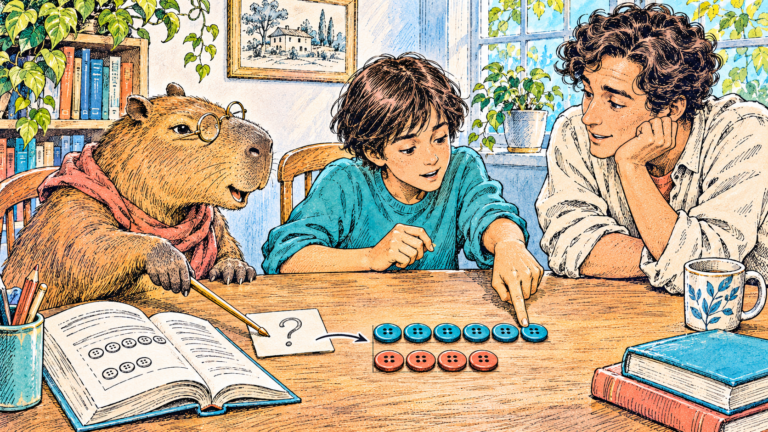
An abstract balance doesn't connect with a purchase. Lay out cards “have”, “will spend”, “will be left”, or use physical units. The quest is to compare two choices with an adult's help. Criterion — showing what remains after each, without requiring quick calculation. If there are many numbers, narrow the range and allow a calculator.
A change in the rule is perceived as a broken promise. Keep the old wording in writing and explain the new one in advance. The quest is to find one change and ask a question about it. Success — the difference has become accessible, even if the child disagrees with it. If tension is high, postpone the discussion; an agreement already in progress isn't rewritten retroactively.
A paid task is hard to organise. Break it into visible stages and agree on help. The quest is to finish one achievable stage. Criterion — a result that meets a condition understood in advance. If a stage is too big, revise the scope. Needing support doesn't in itself become a penalty.
With persistent difficulties and marked distress, individual support is worth discussing separately. A payment system shouldn't serve as diagnosis or treatment.
One sheet for today
Write down three bases for money that already exist in your family. For each, add: who promises, what exactly, when, and how a mistake can be challenged. Amounts can be discussed later. Start where the two sides already understand the rule differently.
If you'd like to turn your agreements and records into a manageable system, you can describe one family situation on the Capybara page. We'll find a method the family can actually use. A good first result is visible without any app: next time both sides open the same agreement.
Capybara
Let's put your family agreements together
Describe one situation involving money or chores. We'll choose a clear agreement and manageable record-keeping for your family — and we'll start in writing.
Tell us about your situationSources
- CFPB (2016). Building Blocks to Help Youth Achieve Financial Capability: A new model and recommendations. Also checked: the official summary of the three components. A recommendation model.
- Joussemet, M.; Koestner, R.; Lekes, N.; Houlfort, N. (2004). Introducing uninteresting tasks to children: a comparison of the effects of rewards and autonomy support. Journal of Personality, 72(1), 139–166. Abstract used.
- Deci, E. L.; Koestner, R.; Ryan, R. M. (1999). A meta-analytic review of experiments examining the effects of extrinsic rewards on intrinsic motivation. Psychological Bulletin, 125(6), 627–668. Abstract used; no universal conclusion about payments is drawn.
- NICE. NG87, environmental modifications. A principle of individual adjustment, not a validation of a family budget.
Read also



 English
 Russian
 Estonian
 Spanish
 French