


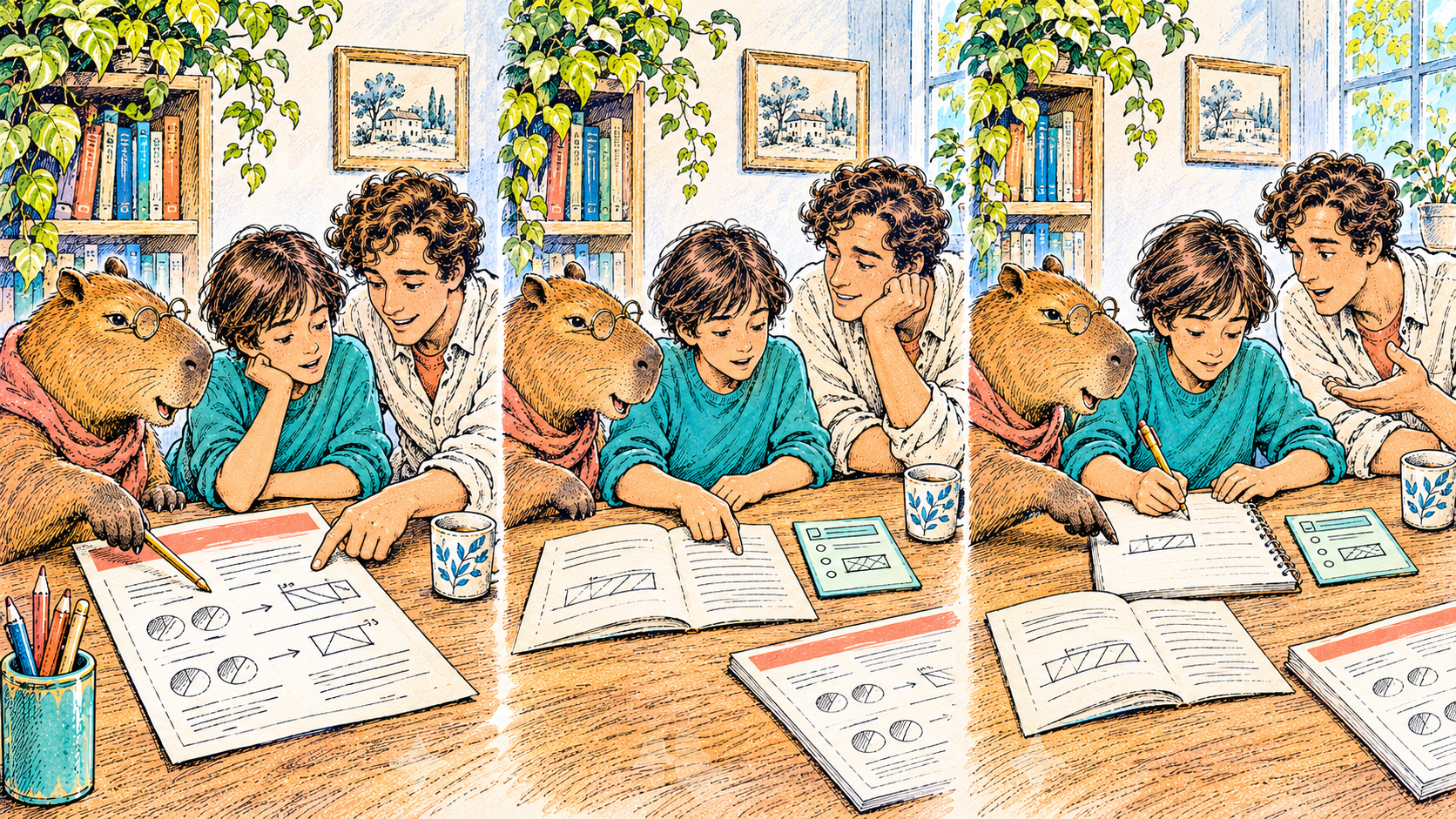
The worked example makes sense, but solving it alone doesn't work
Picture the scene. A child is looking at a printed solution and nodding. The adult asks whether everything is clear. It seems clear at last. The sheet is put aside, the exercise book is opened — and the work stops.
— But you just understood it.
— While I was looking, I understood.
Both are telling the truth. The adult can see the whole route. The child, for now, recognises individual turns when they are shown. Now they have to choose the next one themselves, and that is where a new task appears.
There's no need to go back to the explanation from the very beginning. It's more useful to find a small stretch the child can already do and the nearest step where help will be needed. Success for today can be one well-grounded step.
Recognise, reconstruct, apply
These actions are worth distinguishing right during the session. To recognise is to see someone else's work and agree with it. To reconstruct is to do a step without the ready answer in front of you. To apply is to solve a different problem, noticing what has stayed the same in it and what has changed.
A child can be at different levels even within one example: confidently adding numbers but not explaining the equality; understanding the relationship but losing the order of the written steps. The phrase “didn't understand anything” wipes out this useful difference.
Removing the ready-made walkthrough is one of the techniques I use and show on the Capybara page. Its purpose is to make room for the child's own attempt. At the same time, the necessary accessibility tools stay: having the problem read aloud, large print, a glossary, a neutral reminder card. Independence can be described precisely: “wrote the equation with the adult's question”, “calculated on their own”, “explained orally, the parent wrote it down”.
Such precision helps choose the next step. It doesn't diminish what the child has done.
What memory research shows
In two studies by Ritchie, Della Sala and McIntosh, 2013 , children aged eight to twelve learned new geography facts. Retrieval practice gave an advantage in later recall compared with conditions without it. It's a useful reminder: re-reading material and trying to reconstruct it are different learning actions.
But a geography fact and choosing a mathematical method require different checks. This work does not prove that a covered printout will teach a child to solve new word problems. So after the child's own attempt it's important to look at its content: what relationship they noticed, why they chose the operation, what they did when the problem changed. If the attempt didn't happen, give back the necessary help. The aim of the home cycle is to find the next accessible move; it does not reproduce the research intervention in full.
One equation: where the child's own step appears
Let's take an invented example:
6 + 4 = □ + 3.
It will suit a child who is already familiar with simple equations. If the meaning of the equals sign itself is not yet accessible, start there, without requiring the example to be solved from memory.
During the walkthrough you can show: on the left we got ten; on the right, together, it must also make ten. One addend on the right is three. Which number makes ten with it?
Then ask the child to show or say why both sides must have the same value. There's no need to push for a long explanation in school words. Objects or a drawing can be used.
After that, put the ready-made walkthrough aside. Leave the problem itself and, if needed, a reminder card “compare both sides of the equation”. Give time for the attempt. Don't fill every pause with a new remark.
If the child has written ten in the box, ask: “Check what you get on the right with this number.” That's one question. It points to checking while keeping the chance to notice the mismatch on their own.
Key for the adult, not shown during the attempt: left side 10; the unknown on the right is 10 − 3 = 7; check 7 + 3 = 10. With the answer 10, the right side equals 13, so the equation doesn't hold. This key helps the adult understand the work, not hand the child the answer in a disguised remark.
After the check, ask what has changed in their understanding. If the child found the mistake only together with you, write down exactly that. There's no need to repeat the example straight away until it's flawless.
A similar problem and a changed condition
Offer 8 + 5 = □ + 4. Here the left side is 13 and the box holds 9, because 9 + 4 = 13. This answer is for the adult; the child first needs access to their own attempt.
Changing the numbers lets you see whether the solution is built afresh. However, the structure has stayed the same. For a separate, later check you can move the unknown: □ + 4 = 8 + 5. The answer is still 9, but attention will have to be directed differently.
There's no need to do all the checks in one evening. If a similar example already takes noticeable effort, save the observation and stop. One success doesn't prove lasting mastery; one mistake doesn't cancel the understanding shown a minute earlier.
Sometimes it turns out that the difficulty lies earlier: the child adds up everything they see because they read the equals sign as a command to write the answer. Then it's more useful to work through the meaning of equal sides than to assign another dozen similar exercises.
Why self-explanation also needs moderation
In an experiment by McEldoon, Durkin and Rittle-Johnson, 2013 , 69 children in grades two to four took part; the tasks concerned mathematical equations. Self-explanation prompts gave advantages over a control condition, but compared with additional practice the advantages were more modest and appeared only on some measures.
Another check of scale is McGinn, Booth and Huyghe, 2025: a year-long experiment in 58 fourth- and fifth-grade classes in the USA. No overall significant effect of the intervention with worked examples and self-explanation on the two main outcomes was found. Additional analyses of conditions do not turn the overall result into a guarantee.
So a sensible home try-out is to ask about one reason for a step and watch whether it helps to continue. If explaining turns into a long exam in eloquence, shorten it to pointing, a drawing or a short phrase. The cycle given here is the author's way of organising an attempt, not a protocol tested word for word in these studies.
AI: a key for the adult, a question for the child
To prepare a session, the adult may need the full solution. During the child's attempt a different mode is needed: check the visible work and ask one question that doesn't reveal the answer. These materials are best prepared separately so that the parent's key doesn't accidentally become the next message to the child.
A compact mentor prompt:
Work from the given problem and the child's visible work. Don't guess what is unreadable. Name only the first checkable spot of difficulty and ask one guiding question without the answer, a hidden answer or a full solution. Wait for the attempt. If the child objects, re-check the problem and the work, and allow that you may be wrong. Don't judge personality or effort by the result. Problem and work: [insert].
This is an instruction to the model, not a guarantee of its behaviour. The adult still needs to check the answer. If the AI has declared a correct transformation to be an error, don't make the child give in for the sake of the procedure: go through the disputed point.
A new photo is useful when it's important to see the corrected work. It doesn't serve as proof of honesty and isn't needed for every spoken answer. If the photo is blurry, you can copy out one line or suggest another convenient way to show the work.
Special quests: keep the support and find your own move
What matters here is the observed need. These are options for a home try-out, without a promise that one format will suit children with the same diagnosis. The principle of individual environmental adjustment and written instructions is described in NICE NG87; the guideline did not test the equation-solving cycle given here.
Once the sheet is closed, the sequence disappears. Perhaps the amount to reconstruct is too large. Leave a brief plan without the numerical solution. The quest is to do only one step and point to what it relies on. Criterion — the child's own action with this support. If the step is still out of reach, bring back the worked example and find the beginning together; don't cover it again straight away.
The solution can be explained, but writing is exhausting. Separate the idea from the writing. Quest — the child explains one step, the adult writes down their words and asks them to check the record. Success — the meaning belongs to the child and is confirmed by them. Note the shared form of completion. If tired, shorten the writing or end the attempt; a spoken answer doesn't have to turn into copying out a page.
Checking a mistake causes strong upset. Choose one point in advance and an agreed pause signal. Quest — check only that point together, for example the value of one side of the equation. Criterion — the child managed to take part in a limited check, not necessarily to fix everything at once. If tension rises, stop; the pause agreement must work.
The old algorithm is repeated without taking the change into account. Put the two problems side by side and ask the child to find one difference. The quest doesn't yet require solving. Success — the child shows the changed detail and can discuss it. If there are too many comparisons, change only one element; if needed, go back to objects.
A reminder for one attempt
Choose one example. Make sure the problem is accessible. Work through one step of meaning, remove the ready answer, keep the necessary supports. After the attempt, give one hint and check a specific step. Finish with a note: what worked and what help is still needed.
If the difficulty is persistent and sessions come with strong distress, discuss additional individual support. More rounds of the same explanation don't have to be the next solution.
To begin with, one attempt today is enough, without demanding proof of full independence. If you'd like to choose materials and divide the roles of adult and AI, describe your learning situation on the Capybara page. A reminder card may stay on the table. What matters is that next to it appears an action the child can now do.
Capybara
Let's find the next step together
Tell us where your child loses the thread of the solution. We'll choose supports and divide the roles of adult and AI — and we'll start in writing.
Tell us about your difficultiesSources
- Ritchie, S. J.; Della Sala, S.; McIntosh, R. D. (2013). Retrieval Practice, with or without Mind Mapping, Boosts Fact Learning in Primary School Children. PLOS ONE, 8(11), e78976. The abstract and the task description on the publisher's page were checked.
- McEldoon, K. L.; Durkin, K. L.; Rittle-Johnson, B. (2013). Is self-explanation worth the time? A comparison to additional practice. British Journal of Educational Psychology, 83, 615–632. Abstract used.
- McGinn, K. M.; Booth, J. L.; Huyghe, A. (2025). Preparing 4th and 5th graders to learn algebra with worked examples and self-explanation prompts. Journal of Experimental Child Psychology, 260, 106348. Abstract used.
- NICE. NG87: Attention deficit hyperactivity disorder: diagnosis and management, environmental modifications.
Read also


 English
 Russian
 Estonian
 Spanish
 French