


When AI Becomes Infrastructure. What Will We Get Paid For?
I started my career in IT with Java. Knowing how to write software gave you a very concrete advantage back then: if a business needed a system built around its own rules, it simply wouldn’t get one without people who could code. These days I design systems that use AI, and I find myself wondering more and more what will become of that advantage. I suspect we programmers may end up in the same position as riders after the car came along. You can still ride a horse. You just don’t need to know how for every journey.
My hypothesis is this: any work that relies on predictable ways of thinking will eventually pass to AI. Predictability here is a property of the process. The application may be one of a kind, and the opinion may address a situation nobody has ever encountered. If a system can reliably get from the inputs to the result, verify it and handle the usual exceptions, the work can be automated. The question is what it costs once you account for mistakes, fixes and ongoing maintenance.
Imagine we’re already on the other side of that transition. There are enough chips, competition has ended dependence on a single computing supplier, and AI is affordable for a family or a small workshop. Habits have changed too. Managers, staff and customers know how to use it, and workflows have already been rebuilt around it. Robots can spread through the physical world at their own pace. They still need hardware, installation and maintenance.
In that world, I want to know what happens to work, what we’ll start doing faster and who’ll have the money to buy the fruits of that acceleration.
Programmers, AI operators and the woman who runs the workshop
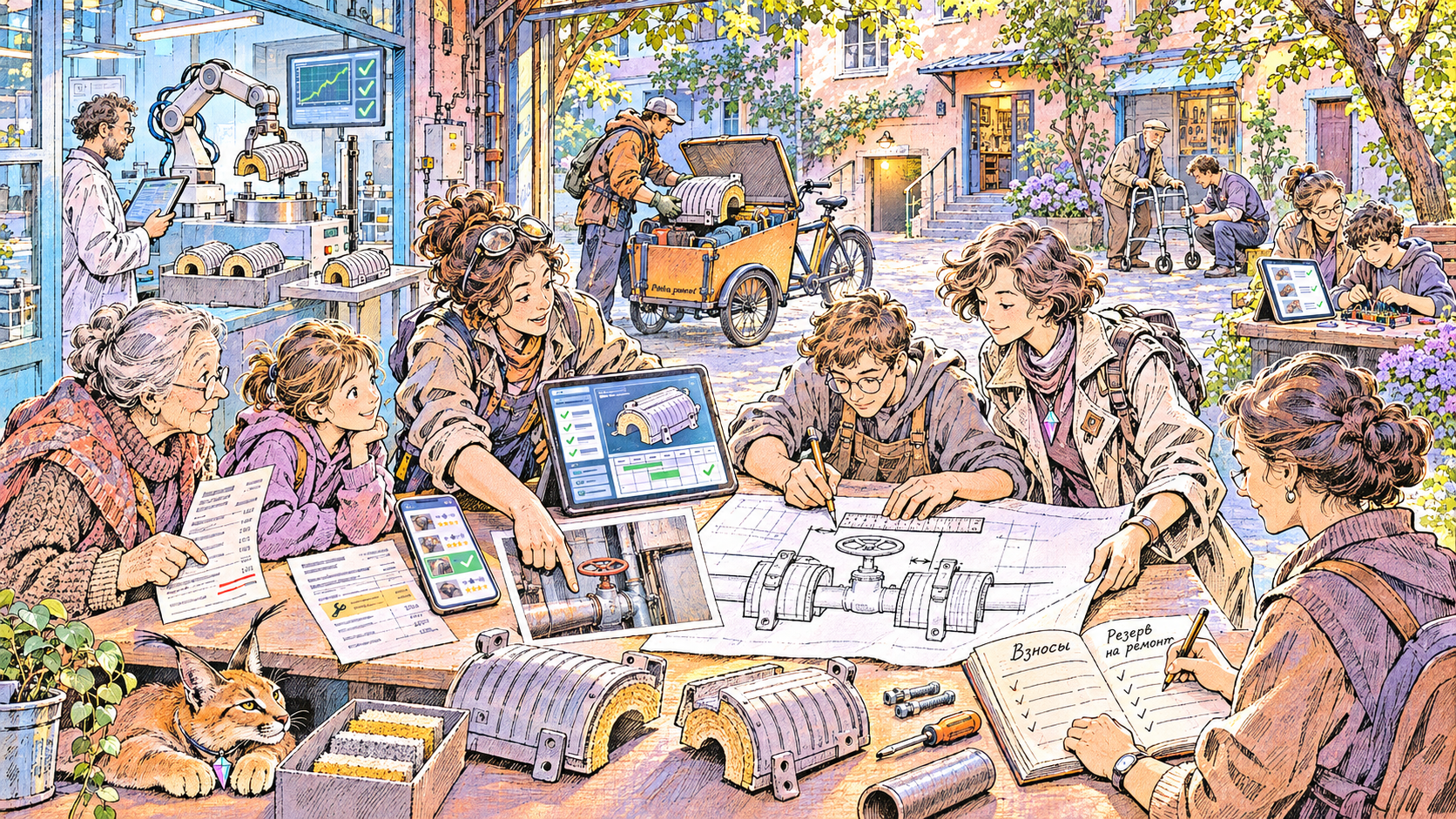
Picture a small workshop. There are appointments, tradespeople with different specialties, and jobs described over the phone as “twenty minutes” that take up half the day. The owner used to have to fit her business around off-the-shelf software or pay for modifications. Now she shows an AI real bookings and exceptions, explains her payment rules and gets an application that fits her workflow. A month later, opening hours and deposit terms change. The software changes with them.
At first an AI operator will sit between the owner and her new system. They gather requirements, connect services and work out why the Saturday booking has disappeared again. Some of those steps then become repeatable, and the system takes them on. Defining the problem, designing the architecture and verifying the result follow the same logic as writing code. More complex work shifts the boundary of automation, and the boundary keeps moving.
That’s what I mean by “IT is becoming a commodity.” Building and changing software becomes an affordable production capability. Software will turn up in places where commissioning a project used to be unthinkable. Shared payments, accounting and data-exchange infrastructure will still be in demand, and applications for individual workshops, families and teams will sit on top of it. Demand for software can be high even as the price of manual development falls and development teams shrink.
I wouldn’t count mathematical thinking out. Ask the AI to maximise bookings and it might do exactly that: the calendar fills up, customers wait, the workers wear themselves out and profit falls. Someone has to spot that bookings, paid jobs and profit are three different quantities. That takes the ability to formalise a problem, test assumptions, look at edge cases and change the objective when it leads somewhere absurd. AI will be able to help with that too. Someone who thinks this way will be able to tackle more complex problems in their own field, whether it’s programming, logistics or learning at home.
There can be more work and fewer jobs
Suppose each service used to take five hours of human work and now takes one. Even with three times as many customers, total human hours fall by 40%. Demand needs to increase fivefold for the number of hours to stay the same. If the lower price opens up a market that buys the service eight times as often, human hours actually increase. For each industry I would ask how much human time is left in each service and how much demand can grow. There’s a second round of effects too: people and businesses can spend the money they save elsewhere. Daron Acemoglu and Pascual Restrepo on automation and new tasks.
I’m particularly interested in how people enter a profession. Where will we find people we can trust with complex work in ten years if beginners stop getting simple work today? In US payroll data through June 2026, researchers found that employment among 22- to 25-year-olds in highly AI-exposed occupations lagged behind that of less-exposed peers, mainly because of weaker hiring. They describe it as an early observation that cannot yet establish causality. In Denmark, the mix of tasks shifted in the first two years after ChatGPT arrived, while researchers detected no appreciable change in earnings or recorded hours. That gives me another reason to watch entry-level vacancies and routes into a profession: average pay may change much later. Stanford Digital Economy Lab · Humlum and Vestergaard’s study of Denmark.
In routine bookkeeping, customer support and administration, one team will be able to handle far more cases. In law and finance, some work will shift to complex disputes, scrutiny of consequential decisions and institutional accountability. A shortage of workers in itself promises no great pay. We can desperately need people to care for older people and still pay them poorly when family and institutional budgets are tight. OECD on demand for long-term care workers.
Science will speed up. Pilot production will have more to do
Science is what interests me most in this scenario. When we can quickly compare huge bodies of research, explore alternatives and design experiments, more hypotheses become worth considering. But if a lab can still test only ten candidates a month, it simply gets a longer queue. Real acceleration begins when we close the loop “hypothesis → experiment → data → next hypothesis”.
Parts of the loop are already visible. AlphaFold 3 improved computational predictions of molecular complex structures. In materials science, A-Lab linked computational screening to physical experiments in an automated laboratory. I draw a down-to-earth conclusion from this: as ideas get cheaper to search for, good measurements, instruments, automated experimentation and independent verification become especially valuable. AlphaFold 3 in Nature · A-Lab in Nature.
Then comes deployment. You can put a digital prototype in people’s hands almost immediately. A new industrial material has to be produced in volume and tested for durability, and a first customer has to change their process to use it. In energy, calculations will speed up before grid installation does. In construction, you can compare designs quickly and the building site will still have a schedule of its own. I expect more work and investment to go where calculations meet the physical world: pilot production, testing facilities and systems that keep things running.
Computing speed alone also leaves a question unanswered. Who sets the research agenda and pays for deployment? We can accelerate the development of cheap energy storage, care tools or ways of keeping people in an app. Each goal has its own sponsors. Progress can move faster, and its direction will still depend on who makes decisions and controls resources.
Personal services become more affordable. Human involvement still has a price
Capybara makes the difference between two kinds of personalisation especially clear to me. It gets cheaper to create exercises for a specific gap in a child’s understanding, set the pace and prepare the next lesson. Finding out why nobody at home wants to open the notebook again after a good session involves family habits, expectations and agreements as well. A family might pay a mentor if it matters that a particular person knows the situation and can come back in two weeks to see what actually worked.
Care, repairs, mentoring, household services and creative work could follow a similar pattern. AI takes on part of the preparation, translation, booking and coordination. A small team can take jobs that used to be too small or unusual to be worthwhile. In media the same process looks almost reversed: digital output grows, the price of an individual piece may fall, and access to an audience and ongoing relationships with creators carry more weight. In both cases affordable tools lower production costs. Providers’ incomes also depend on how many customers they can find and what those customers will pay for.
I see a direct link to what I’m designing in DOGEstonia. Imagine that different AI assistants can find offers from small shops and service providers. A little workshop can come up in a search for a particular job even when the customer has never heard of it. If most people choose through one assistant that controls both the results and the transaction, the workshop has a new gatekeeper. That’s what interests me about an open registry of business nodes: who decides which offers the customer sees as more and more searching and choosing are delegated to machines? OECD on competition and agentic AI.
What will we use to buy all this abundance?
For me this is the central question. Savings from automation can reach buyers as lower prices, workers as income or free time, owners as profit, and society as tax-funded services. The same access to AI can produce very different outcomes.
Imagine a family whose earnings fall. It can get translations, learning materials and its own app for free. That’s a real gain. But if housing, food, energy and care take up most of its budget, purchasing power depends mainly on those prices. Where supply is constrained, as with housing in a desirable neighbourhood, some of the money saved can flow to the owners of the scarce resource. Investment in equipment and science can boom even as households become more cautious about what they spend on themselves.
I see several arrangements that can easily coexist.
- Income concentrates among owners of assets and sales channels. Cheap digital services become widespread. Personal involvement is more often bought by well-off families and large organisations.
- The returns from higher productivity are shared more widely through ownership. Employees can hold stakes, and co-operatives, pension funds or public funds can hold productive assets for a broad group. Families earn additional income when their stakes are backed by assets that actually generate revenue.
- Part of the gain returns through public services, transfers and working-time agreements. A shorter week leaves time for children, learning and personal projects if income still covers the cost of living. Transfers expand choice, while access to care or housing also depends on how much can actually be supplied.
IMF on sharing the gains from generative AI · Korinek and Suh on economic scenarios for deep automation.
I recently wrote about what to study when professions change faster than curricula. For one family, the question is what skills and interests can help a person shape their own path. At the level of the economy there’s another. If people can produce more by working less, who gets the time that’s freed up and who gets the income? The answer determines whether a family can benefit from what this economy makes possible, pay for the help it needs and choose what to do with its own time.
For your business
Let’s start with one process in your company
If your team manually collects contractors’ reports, clarifies details in messages and transfers agreed information into documents, describe one such process. We’ll explore what can be automated and which decisions should stay with your team — starting in writing.
Review my processRead also




 English
 Russian
 Estonian
 Spanish
 French