


In-game purchases: how to discuss price and choice with your child
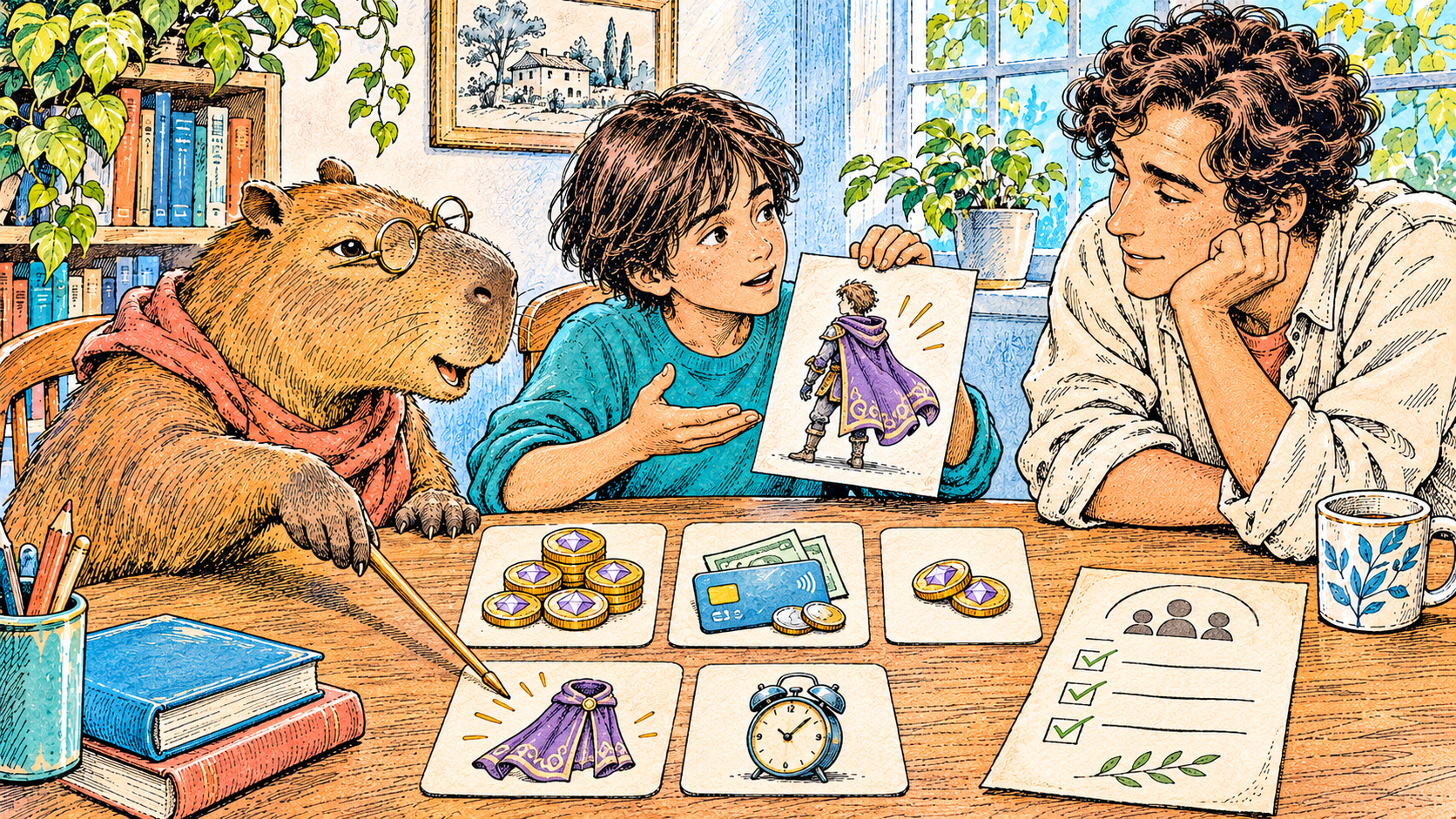
Picture an invented conversation. A child shows the adult a cloak in a game. Their character could wear it when meeting friends.
— It's just a picture, — says the adult.
— It's my character.
— And how much does the picture cost?
— Two hundred.
The adult is already alarmed. The child meant game units. Before arguing about whether the purchase makes sense, they first need to agree at least on the unit of measurement.
For a child, a digital item can be connected with creativity, play or belonging to a group. The adult has the right to limit spending. You can listen to the meaning of the wish even when the answer about paying for it will stay no. It's better to name that limit straight away than to invite the child to prove the value of their hobby in the hope of a yes that won't come.
First find out what is being bought
Ask the child to show the offer and explain what will change after paying. Concrete curiosity helps here: does the item stay, or does it work only for a while? Does it change the look, speed something up, open access? What happens if the purchase is skipped?
The words “everyone has already bought it” can also be clarified: who exactly, what the item is needed for in shared play, whether there is a way to take part without it. You don't have to refute every detail. What matters is to understand what the child is trying to get and to set it against the family's means.
The adult can admit their own preferences: we too buy things for pleasure, and others don't always find them necessary. That's a reason to speak more clearly, not an obligation to pay for every wish.
Four mechanics, four sets of questions
| What is on offer | What to check before deciding |
|---|---|
| A known digital item | What exactly will be received, for how long and on which account |
| A speed-up or advantage | Which action changes and whether there is an accessible option without paying |
| A subscription | The payment period, repeat charges and the conditions for cancelling |
| Random contents | What is bought is a chance, not a known desired item in advance; the price of each new try remains an expense |
This distinction doesn't make any purchase useful or harmful. It helps name what the agreement is about. Buying a specific cloak and paying for a random chest call for different decisions, even if both buttons are on the same screen.
This article uses an invented game. Prices, rules and interfaces of real services are not described here. For a specific subscription or setting up purchase controls, you'll need to check the current terms of the service itself.
What is known about paid random rewards
A study by Hing and colleagues, 2022 looked at two survey samples of Australian adolescents aged 12–17. Buying loot boxes — paid random rewards — was linked to problem gambling even after accounting for a number of other factors, including taking part in gambling for money.
A survey association doesn't establish that the purchase caused the problem. The result can't be transferred to every younger child or to every known digital item. For a family conversation, the specific question matters: are we paying for a particular product or for a chance to get what we want? A failed attempt doesn't turn the next one into a promised win. A family can separately say no to paid random rewards while still discussing the purchase of a known item. That's a family rule, not a diagnosis based on an interest in games.
Two hundred units: let's count the real cost
All the numbers below are invented and don't relate to any real game. Suppose a pack of 500 units costs 5 euros, and the known item costs 200 units. Before buying, the game balance is zero; only whole packs like this are available, with no fees or discounts.
The nominal share of the item's price is 200 / 500 × 5 = 2 euros. But paying now will take 5 euros for the pack. After buying the item, 300 unitswill remain. The remainder is not three euros in a bank account: in our example there is no exchange back.
If another such item is bought later, 200 of the remaining 300 units are used and 100 are left. No new payment is needed for now. The two items used 400 units, notionally four euros of the pack; in fact the family has already paid five euros.
| Choice now | New payment | What will remain |
|---|---|---|
| Don't buy anything yet | 0 euros | Starting balance: 0 units |
| Buy a pack and one item | 5 euros | The item and 300 units |
| Buy a pack and two such items | 5 euros | Two items and 100 units |
The table doesn't advise buying the second item to “justify” the pack. It shows the different consequences. You can also compare with another purchase outside the game, but without a winner chosen in advance: the family needs to understand what it is willing to spend the real five euros on.
One agreement about time, a separate one about money
Paying for an item doesn't in itself decide how long the child can play. A time limit doesn't answer the question of which purchases are allowed either. It's easier to write two short rules and check that the child tells them apart.
In an imagined family the agreement might sound like this: we discuss spending before paying; new packs aren't bought without an adult; we keep track of the remainder; the next budget conversation is on a day named in advance. For time, we separately choose an acceptable duration and a way of finishing that takes the game's design into account. This is an example of a structure, not a norm for duration or amount.
The conversation about the cloak might go on:
— I understand it's important to you to show your character to your friends. Buying it right now means paying five euros. This week I'm not putting any new money into the game.
— But the offer will end.
— Maybe we'll miss it. I'm not promising to buy exactly this cloak later. We can write the wish down and, on the agreed day, see which options are available.
The limit is unpleasant for the child, but there's no trap in it. The adult doesn't offer to buy what they've already decided to forbid, and doesn't demand agreement that the wish is silly.
Understanding the price and waiting are different tasks
A child may convert the units correctly and still find the delay hard to bear. A systematic review by Paiva and colleagues, 2019 looked at delay discounting of rewards in children under 12 with ADHD and autism. Six studies were included; only one on autism. This limited evidence base doesn't define a single profile and doesn't test a family budget or a game interface.
So a difficulty with waiting shouldn't be explained from one episode or turned into a judgement of character. For a home try-out, you can mark in advance when you'll return to the question and set an external limit on unagreed purchases. Check whether this arrangement is manageable for this particular child. If tension grows, it's more important to reconsider the load and the support than to repeat the price calculation ever louder. An explanation doesn't have to make the wish disappear at once.
The urgency label in our invented offer is a circumstance of the choice. We don't draw conclusions from it about a specific brain mechanism or a proven design effect. A family can decide in advance that new spending isn't agreed while in a hurry.
Special quests: price, transitions and predictability
These are options for individual adjustment. The NICE CG170, 1.1.9 guideline describes attention to visual and sensory needs in supporting autistic children; it is not a test of the effectiveness of quests about purchases. Choose based on the observed difficulty, not on an assumed diagnosis.
Game units seem unconnected to money. There may be a need for a visual conversion between two scales. The “Price Detective” quest: using an invented example, compare a pack of 500 for 5 euros and a pack of 1,000 for 10 euros when one item costs 200 units. Show the full payment and the remainder. Success — the child tells the price of the pack from the share of spending; a calculator and help are allowed. If the comparison is overwhelming, keep just one pack.
Leaving mid-game is very hard. Discuss in advance an available stopping point and a warning before the transition. The quest is to find such a moment together before the game starts and practise one transition with support. Criterion — the agreement turned out to be doable, without demanding an instant switch. If the game doesn't fit within the family's limits, rethink the session format in advance.
An urgent offer causes strong tension. Take the shop off the screen after saving the information and name a specific moment for discussion. The quest is to write down one wish and come back to it then. Success — the child managed to use an external support; the purchase isn't required. If waiting turns into anxious guarding of the screen, shorten the task and help them get out of the situation. A pause shouldn't be a threat.
A new limit looks like breaking the old agreement. Put the previous and the future wording side by side. The quest is to find what stays and what will change. Criterion — the rule can be retold or shown, even if the child disagrees. Give time to get used to it; don't change what was promised retroactively.
If the interface overloads with sound and movement, options can be discussed using a calm paper record. There's no need to endure discomfort for the sake of learning about budgets.
If a purchase has already gone wrong
First, restore the facts: how much was actually charged, what was received, whether there are repeat payments. Whether a refund is possible and the terms of the specific service need to be checked separately. A universal “never refund, let them learn” doesn't replace looking into the situation.
You can talk about the disappointment without public shaming. Then decide which record and which rule to change. With hidden spending, significant loss or marked distress, extra help from an adult is needed, and if necessary from a specialist; one conversation about price may not be enough.
Today, choose one purchase and fill in three lines: what we get, how much we pay now, what remains. If you'd like to set up agreements and record-keeping for your family, tell us about one situation on the Capybara page. The consulting includes choosing and setting up tools; the family dashboard is still in development for clients. A record-keeping system doesn't promise to cure problem gaming. It can start with a clear record of those very two hundred units.
Capybara
Let's agree on price and choice
Tell us about one purchase or one argument around a game. We'll set up rules and record-keeping your family can stick to — and we'll start in writing.
Tell us about your situationSources
- Hing, N. et al. (2022). Loot box purchasing is linked to problem gambling in adolescents when controlling for monetary gambling participation. Journal of Behavioral Addictions, 11(2), 396–405. Abstract used: surveys, causation not established.
- Paiva, G. C. C. et al. (2019). Temporal Reward Discounting in Children with ADHD, and Children with ASD: A Systematic Review. Developmental Neuropsychology, 44(6), 468–480. Abstract used; a small evidence base, especially on autism.
- NICE. CG170: Autism spectrum disorder in under 19s: support and management, 1.1.9. The principle of individual visual and sensory supports.
Read also


 English
 Russian
 Estonian
 Spanish
 French